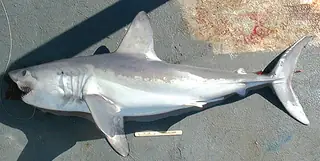
Common thresher
Alopias vulpinus
Sharks and rays · family Alopiidae · order Lamniformes
Vulnerable on the IUCN Red List
About
The common thresher, also known as Atlantic thresher, is the largest species of thresher shark, family Alopiidae, reaching 6 m (20 ft) in length. About half of its length consists of the elongated upper lobe of its caudal fin. With a streamlined body, short pointed snout, and modestly sized eyes, the common thresher resembles the pelagic thresher. It can be distinguished from the latter species by the white of its belly extending in a band over the bases of its pectoral fins. The common thresher is distributed worldwide in tropical and temperate waters, though it prefers cooler temperatures. It can be found both close to shore and in the open ocean, from the surface to a depth of 550 m (1,800 ft). It is seasonally migratory and spends summers at lower latitudes.
From Wikipedia, CC BY-SA 4.0.
Where it has been recorded




- Records
- 75,122
- Countries
- 48
- Recorded
- 1800–2026
Most records come from
- United States 71,719
- Chile 1,916
- Australia 392
- New Zealand 224
- Faroe Islands 120
- France 70
- Germany 57
- United Kingdom 35
- Netherlands 35
- Philippines 34
- Canada 18
- Norway 18
Records are places where people found and reported the animal, from GBIF; fossils and zoo animals are left out; museum specimens and tracking studies count, and well-studied countries have far more. Squares on the map: brighter means more records.